


Famous Exotic Animals in Australia
- Taylor Choi

- Jul 22, 2019
- 9 min read
Updated: Jul 27, 2019
Hi guys. If you guys already read my old posts, well done. You are getting familiar with Aussie animals. As you know Australia is vast and considered as a single continent rather than an island because of the size. So, there are many indigenous animals which are difficult to see outside of Australia. I cannot cover every exotic animals, but here are some famous animals to see.
So, let's have a look.
Koala

Koalas are well-known Australian animals that is a herbivore and spends most of its time sleeping whilst being attached to a tree. Koalas are one of the national symbols of the Australian’s unique wildlife and can only be found on southeast and eastern sides of Australia. They are found hanging onto eucalyptus trees of native bushlands and forests, between the forks of tree’s branches.
The term ‘koala’ means ‘no drink’ in the Aborigines language, because they believed that koalas don’t need to drink because of the moisture they get from munching on eucalyptus tree leaves. They do drink water, especially during heatwaves and in times of drought, but do not drink much water. Koalas sleep more than most animals, can sleep up to 18 hours a day, which helps them to conserve energy.
Dingo

Dingo is well known as Australian wild dog, but it actually originates from Southeast Asia, where it can be found even today. Dingo can survive in different types of habitat. It usually inhabits woodland, grassland and edges of the forests with limited access to water. Fast spreading of European settlers across Australian continent led to accelerated loss of dingo's habitat. Other than that, dingoes began to mate with domestic dogs. As a result, one third of remaining dingo population in Australia is a hybrid formed by mixing of genes of dingoes and domestic dogs. Number of pure dingoes is very small and they are considered endangered species.
Dingo can reach 3.5 to 4 feet in length and 22 to 33 pounds in weight. They have bushy tails that is usually 12 to 13 inches long. Colour of dingos' fur is usually reddish-brown and covered with white markings. Dingo has pointed muzzle and big canine teeth and very large, upright ears, also they are able to rotate its head for almost 180 degrees in both directions.
Unlike other dogs, dingo does not bark. They howl like a wolf. Communication between animals is accomplished via howls, urine marks and rubbing of scent. Meat is main source of energy and they usually hunt rabbits, wallabies, kangaroos, birds, lizards and domestic animals. They sometime eat berries and fruit and hunt mainly at night.
Echidna

Echidna has spines like porcupine, a beak like a bird, a pouch like a kangaroo and lay eggs like reptile. They somehow look like hedgehogs. They are native to Australia, Tasmania and New Guinea. Their bodies are covered with 2-inch long spines, where their spines are actually modified hairs. There’s fur between the spines to provide insulation.
These animals have the lowest body temperature for mammals (32 Celsius) and have a life span up to 50 years (where most wild animals live for 45 years) due to their low body temperature and slow metabolism.
Interestingly, male echdinas have four-headed penis where when they have sex, two of the heads shut down while the other two grow bigger to fit into the female’s two-branched reproductive tract. Other than platypus, echdina is the only mammal that lay eggs out of mammals. These are toothless mammals, but their long, sticky tongue acts as teeth to slurp up ants, worms and insect larvae.
Platypus

Platypus is one of nature’s most unlikely animals and were described as ‘hodgepodge’ of other species. They have bill and webbed feet similar to ducks, tail similar to beavers and the body and fur like an otter. Males are venomous, as males have a hollow spur on each hind leg from which venom is dispensed. Although the spur is always there, venom is only produced during mating season, indicating that it is used for competing with other males.
They hunt underwater, but can only stay in water for a few minutes. They are the bottom feeders, scooping up insects, larvae, shellfish and worms in their bill along with bits of gravel and mud. They store these food in their cheek pouches and at the surface, are mashed for consumption. They don’t have teeth so bits of gravel help them to “chew” their meal. Along with echidna, they are the only mammals that lay eggs. Their bill is comprised of thousands of cells that give a sort of “sixth sense”, allowing them to detect the electric fields generated by all living things. It is so sensitive that they can hunt with their eyes, ears and nose all closed, just relying on the bill’s electrolocation. Their tails are not used to move in water or slap the water for warning; it’s used to store up nearly half of the animal’s body fat in case of food shortage. Females use their tails to also incubate eggs against her warm body.
Wombat

Wombats live in burrows that are in open grasslands and eucalyptus forests. Wombats are herbivores and nocturnal, so they find food at night on grasses, roots and bark. Although they look slow, they can run up to 25 miles an hour. They are built for digging, their barrel-shaped bodies and wide, strong feet with long claws enable them to excavate tunnels and chambers.
They are suited for hot and dry habitat like Australia, because it takes wombats up to 14 days to digest a meal. Their teeth continuously grow so to wombats gnaw on bark and tough vegetation to keep them short. They mark their territories by ‘defecating’, their poop is square and it is believed to prevent it from rolling away. Their predators are Tasmanian devils and dingos and wombats protect themselves on their back made up mostly of cartilage, making them more resistant to bites and scratches. At the end of a chase, they will dive into their burrows and block the entrance with their butts. They’re also capable of using their powerful backs to crush the skulls of intruders against the roofs of their burrows so they are not as powerless as they seem. They’re naturally shy animals. They may look cute but, if you look at them with your eyes, it might be different. Wombats are about as big as a medium-size dog, typically 30 inches (76 centimeters) long. The common wombat weighs 25 to 40 kilograms and they often come out to roads at night. This 'big' cutie can be very dangerous and scary if you drive at night.
Macrotis

Macrotis (aka Greater Bilby) are small, rabbit-sized animals that live in the arid, desert regions of Australia. They have pointed heads and a narrow snout, and they don’t have very good eyesight and rely on their hearing and sense of smell to find food and to sense danger.
Also, their long sticky tongues help them to lick up seeds from the ground and sand, which end up as their poops. They don’t drink much water as they are able to obtain enough moisture from their food, and this is the reason their survival in arid regions are successful. They are nocturnal and only emerge from their burrows at night. They are omnivores, eating on a range of foods including insects (especially termites) and their larvae, seeds and fungi, bulbs and fruit. They are becoming less protected!
Wallaby

Wallaby are members of the kangaroo clan, but are smaller than kangaroos. They are also found in New Zealand (introduced) and a few population in U.K. They have powerful hind legs they use to bound along at high speeds and jump great distances. When wallabies are threatened by predators, or when males battle each other, they use these legs to deliver powerful kicks.
They are herbivores and bulk of their diet is grasses and plants. Their tails are not used for gripping, but used for balance and for support when sitting. They have elongated faces and large, flat teeth necessary to chew through vegetation. Wallabies have different kinds and as a whole, portray a diverse set of behaviours. Large species are mostly active during the day and smaller species tend to be nocturnal, mostly active at night. Smaller species are often solitary, but larger species often live/feed in groups of up to 50. I'm sure that you have seen photos of Kangaroos, and if you thought they look cute and cuddly, it's VERY likely the photos of wallabies. You will see bunch of wild Wallabies and Kangaroos in Australia and can differentiate easily by looking.
Kangaroo

See the difference? The young Kangaroos are similar with Wallabies but, the adult ones are distinctively different. Because, when they get old, they start walk with 4 legs, and it make their fore arms very muscly.
They are unofficially Australia’s national animal. They’re just bigger versions of wallaby. They are of cultural and spiritual significance to Aboriginal people across Australia. Their meat continues to be protein source, pelts used for clothing and rugs and their skin crafted into water bags.
There is myth that the name kangaroo is the result of a misunderstanding and developed from an Aboriginal word meaning “I don’t know”, or I don’t understand”. Kangaroos are the world’s largest marsupials, where a red kangaroo can weigh 90 kg and grow up to 2 m tall. All kangaroos have short hair, powerful hid legs, small forelimbs, big feet and a long tail. They are famous for their means of locomotion: hopping. They can reach speeds of 60 kph, a single hop is more than 8 m. their muscular tails used for balance when hopping and when swimming.
They are good swimmers and swim to avoid predators and can use their forepaws to drown pursuers. Their natural predators include dingoes, humans, wedge-tailed eagles. Kangaroos can’t move backwards, so Australia has coat of arms feature emu and the kangaroo, as these two animals can only move forward as symbols of national progress. They are famous for their forward-opening pouch where the joey (baby kangaroo) develops and drinks milk from mammary glands. Kangaroos are most active between dusk and dawn, and they search for their favourite foods: grass, leaves, ferns, flowers, fruit and moss. So, the roadkill of Kangaroos at night are pretty common in Australia (unfortunately).
They are herbivores. They also regurgitate their food, chewing it twice before it passes through their stomach. Kangaroos live in “mobs” of about 10 individuals.
Tasmania Devils

Tasmania devils is the Looney Tunes representation! It is not different from how they are portrayed in the TV series, as seething, snarling, insatiable lunatic. They are seen as “cantankerous” and will fly into a maniacal rage when threatened by a predator, fighting for a mate or defending a meal. Early Europeans named it “devils” after witnessing their teeth-baring, lunging and an array of spine-chilling guttural growls. They are carnivores, surviving on small prey such as snakes, birds, fish and insects. Like other marsupials, their tails swell with stored fat. They are solitary and nocturnal, spending their days alone in hollow logs, caves and emerging at night to feed. They use their long whiskers and excellent sense of smell and sight to avoid predators and locate prey. When they find their prey they will eat everything, consuming everything including hair, organs and bones. Now Tasmanian devils are indigenous only to Tasmania.
Quokkas
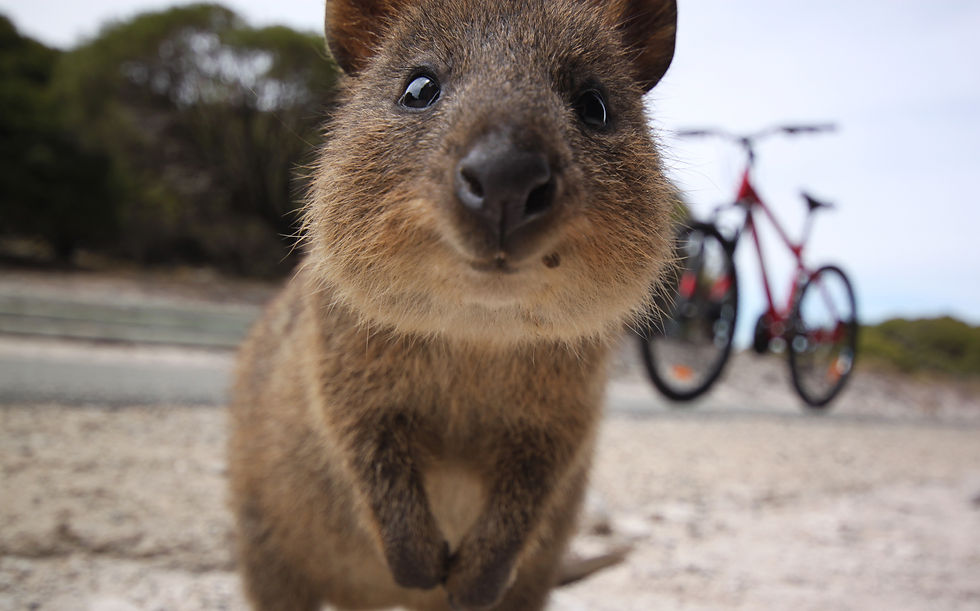
Quokkas can only be found in 3 islands in Australia, where Rottnest Island in Western Australia is the primary home for quokkas. Even though they are not endangered, very few habitats they occupy put them at risk due to urban growth and ever expanding agriculture. They rarely drink water, because they extract most water they need from the plants they eat, which are Guichenotia (a flowering bush). They eat leaves and grass, but don’t chew their food – they rip out vegetation, stuff it into their mouths and swallow then regurgitate their food and eat it again. The regurgitation is a lot more processed, so their digestive systems can better extract the vital nutrients from it the second-time round.
They have fat stored in their tails. They primarily feed at night and are nocturnal. Quokkas are not afraid of humans and have a few natural enemies, because they have been isolated for too long. Quokkas are believed to be the world’s happiest animals and are extremely sociable animals, but it is illegal to make pets out of them. Some to smile and are viewed very cute to humans. But zoologists don’t think this is true. They’re not even allowed to be touched. When quokkas are cornered, provoked or attacked, they let out a loud shriek. If that doesn’t work, they will attack with their sharp fangs and claws. The Rottnest Island Infirmary claims to treat about a dozen patients every year for quokka bites and scratches.
Emu

Emu is Australia’s national bird. Adult emus are covered with shaggy grey-brown feathers except for the neck and head. They live in Sclerophyll forest (a type of vegetation that has hard leaves, short inter-nodes [the distance between leaves along the stem] and leaf orientation parallel or oblique to direct sunlight.) and savanna woodland. They eat fruits, seeds, growing shoots of plants, insects, other small animals and animal dropping. They communicate with each other by booming, drumming and grunting, where booming is created in an inflatable neck sac and can be heard up to 2 km away.
They have been ‘clocked’ at 50 kph and can run great distances too, if needs be.
Even though its flightless, the emu still has wings. The emu uses them to cool themselves down. They stretch them out and allow air to move around the body. They also use them when they’re running at top speed to steer themselves in the right direction.
Emus are ‘nomadic’. This means they don’t stay in one spot for very long and take advantage of the food that is available in an area and move on when they need to.
One interesting thing is, the females do not sit on eggs. Once the eggs are laid its up to the male to sit on them for roughly eight weeks.
Comments