


The top 10 Deadliest Creatures in Australia
- Taylor Choi

- Jul 20, 2019
- 8 min read
For those who now realise that Australia is a lot greener than our expectations, or already knew, Welcome to Australia! Now we've got to consider one very important thing. The DEADLY animals in Australia.
"What do you think the most dangerous animal in Australia?"
Every time when I asked this question to my tourists, their answer was
"Of Course, Kangaroos!"
Well, it is kinda true, yeah especially when they come out from bush in the middle of night, yes they certainly can be your nightmare, but I will tell you the real dangerous ones.
Here the top 10 the ACTUAL mates which can lead you into big troubles.
10. Stonefish

You wouldn’t think that a fish would be that deadly. Most of us watch them in Fish Markets or Aquariums or keep them in a bowl with the name of Dory or Nemo. This isn’t the case with the stonefish, which is considered to be one of the deadliest fish in the world.
Its name comes from its ability to camouflage itself within a coral reef, especially in "Great Barrier Reef". In fact, the stonefish can come in a range of colors depending on its habitat.
Although it mostly eats other small fish, you may end up swimming with the fish if it comes into contact with you. NEVER try to touch or say Hi to them!
The fish’s dorsal fin has spines that are sharp enough to pierce the soles of boots (as well as skin). These spines contain venom sacs. If they pierce human skin, it may cause intense pain that lasts for several hours.
But it gets much worse: You would then experience shock, hypertension, paralysis, and finally death. This occurs often when we dive in clear sea with bunch of rocks or fishing. Make sure you watch the fish on the fishing rod before you grab them!
9. Redback Spider

Here’s one of the most famous arthropods in Australia. Yes, it certainly has creepy-looking but also one of the coolest-looking ones. These spiders are located throughout Australia especially in Outback. The creature’s name comes from the bright red stripe that covers the abdomen of the female spider as something of a warning. Redback Spider bites are RELATIVELY common in Australia and around 2,000 people are bitten each year.
However, the bite of the spider can cause a range of symptoms including muscle rigidity and twitching, vomiting, labored breathing, rapid heart rate, hypertension, weakness, and sweating. The venom may also cause death unless it is quickly treated with antivenom. So, you MUST visit emergency hospitals or call "000" for ambulance if you get bitten by these. The fact that these spiders are found throughout Australia means that you’ll be double-checking every single thing that’s red. "They are in nowhere but in anywhere."
8. Inland Taipan

Native to Australia, the inland Taipan is a huge snake that blends in with the desert environment in which it lives. They inhabits the black soil plains in the semi-arid regions where Queensland and South Australia borders converge. These snakes can grow to more than 2.5 meters (8.2 ft). The venom within the snake’s 12-millimeter (0.5 in) fangs can kill almost 100 men with a single drop! With just one bite, they can slow down a man’s heart rate gradually and increase the possibility of a stroke.
The only saving grace is that these snakes are largely found in less populated areas. so, fortunately, it is relatively likely to see these Taipans while you are travelling in Australia. Have I seen them before? Fortunately Not!
7. Great White Shark

Here we go. A predator that you might have expected before reading this. The Great White Shark makes us look into the black darkness of the ocean and take a big gulp thinking of how many are circling around us. Too many times we’ve watched Jaws and thought we’d never go near the ocean again.
These Great Whites can grow over 6 meters (20 ft) long and weigh up to 1,800 kilograms (4,000 lb), big enough to kill multiple people. There have been almost 700 unprovoked attacks involving Great Whites in Australia. Around 200 of these attacks were fatal; almost 400 caused injuries. Their teeth are basically a set of over 100 custom-made knives that can rip you in half quicker than you can put a shrimp on the barbie! (an Aussie term of barbecue, not the famous doll)
But let's be fair. Don’t worry too much about sharks. Use caution when swimming at dawn and dusk near seal colonies. This is where and when Great Whites feed. So, if you visit some famous beaches with regular Lifeguards, you won't see these mates.
6. Red-Bellied Black Snake

Okay. Another Snake. It seems to be a recurring theme that the color red signifies a deadly animal in the Land Down Under. The Red-Bellied Black Snake. I'm pretty sure that you are not familiar with this name because this one is an endemic snake in Australia, and it can grow up to 2 meters (7 ft) long.
With its black exterior, the snake blends into the night when hunting both us and its normal diet of frogs. But the snake’s bright red belly shows in the night like a Neon Light. The venom from its bite can cause skin cells to die off. It can also cause kidney failure and death if not treated quickly with antivenom.
Why is this more dangerous than Inland Taipan? It's because of its distribution.

This map shows where this snake inhabits. They are native to the east coast of Australia, where it is one of the most commonly encountered snakes.
It can be found in the urban forest, woodland, plains, and bush-land areas from Adelaide, Melbourne, Canberra, Sydney, Blue Mountains, Brisbane to Cairns.
I know you'd love to travel around NSW including Sydney yeah? Then, this is important to remember! It is most commonly seen close to dams, streams, billabongs (Australian oxbow lakes), and other bodies of water, although they can venture up to 100 m (350 ft) away, including into nearby backyards. In particular, They prefer areas of shallow water with tangles of water plants, logs, or debris. So, if you like to explore some bushes, always use your caution not to encounter this!
5. The Blue-Ringed Octopus

The blue-ringed octopus is a sea animal that seems like it’s straight out of Pirates of the Caribbean. You might have seen this species before, because it is widely spread in Pacific and Indian Ocean. With its beak and long, tentacle-like arms, this octopus is most likely to be seen while it’s lying around not doing much.
But when it senses danger, it lights up like fireworks at Harbor Bridge with blue rings and lines along its body. One good thing is that this octopus is not as territorial and aggressive as other animals in this list.
However, if those warning signs aren’t and you go by or contact with its venomous bite, then a serious matter will occur. They are recognized as one of the world's most venomous marine animals. Despite their small size (12 to 20 cm) and relatively docile nature, they contain the powerful tetrodotoxin. Yeah, the toxin which blowfish has. They carry enough venom to kill twenty-six adult humans within minutes.
Their bites are tiny and often painless, with many victims not realizing they have been envenomed until respiratory depression and paralysis start to set in. Then you will start suffer muscle weakness, respiratory failure, and death. Until now, no Blue-Ringed Octopus antivenom is available. As I said before, if you visit some famous beaches with regular Lifeguards, it's very likely to see these octopuses.
4. Funnel-Web Spider

Yeah, another creepy-looking wildlife. The funnel-web spider is considered as one of the nastiest arachnids in the world. Although there are multiple species, the Sydney variant won’t be getting any invites to family gatherings from its cousins due to how much deadlier the Sydney spiders are.
Funnel-web spiders can grow to 1–5 centimeters (0.4–2.0 in) in length and can be a variety of colors from black to brown. The primary range of the Australian funnel-web spiders is the eastern coast of Australia, with specimens found in New South Wales, South Australia, Victoria and Queensland. The only Australian states or territories without members of this family are Western Australia and the Northern Territory.
What make them nasty are their fangs and venom. Their fangs are large and powerful, capable of penetrating fingernails and soft shoes. The venom from the hairy spider’s massive fangs attacks a person’s nervous system, causing foaming around the mouth and random muscle spasms. If left untreated, the spider’s bite can cause death.
If that isn’t bad enough, this all happens within two hours.
This hairy and black spider is commonly found in suburban rockeries and shrubberies, rarely in lawns or other open terrain. A burrow characteristically has irregular silk trip-lines radiating from the entrance. Unlike some related trapdoor spiders, they do not build lids to their burrows.
Australian funnel-web spiders make their burrows in moist, cool, sheltered habitats – under rocks, in and under rotting logs, some in rough-barked trees (occasionally metres above ground). So, if you guys love to explore shady bush, hiking suits and boots are recommended as your primary armour. As long as you guys walk on guided tracks in forests, the chance of meeting these is pretty low.
3. Saltwater Crocodile
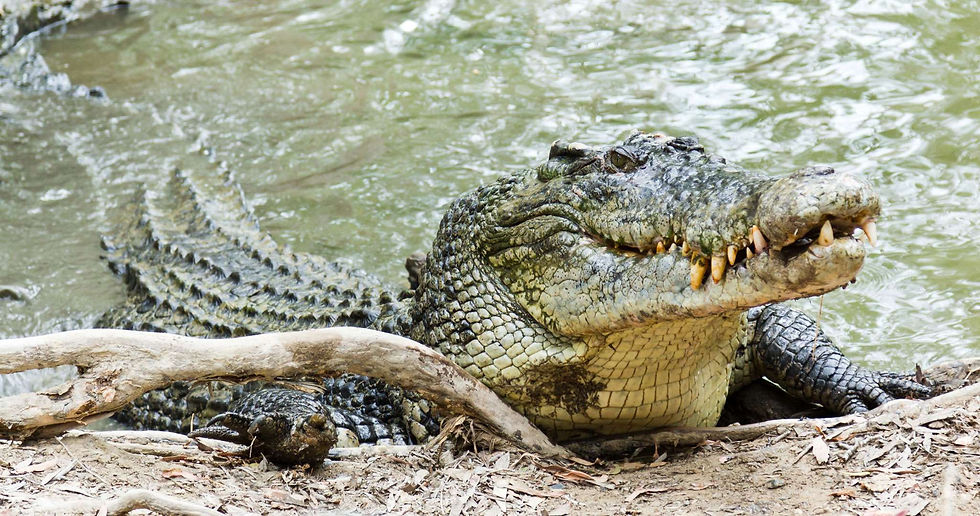
There is nothing subtle about the killing prowess of the saltwater crocodile (aka Saltie in Aus.). With over 100,000 crocodiles skulking throughout Australia’s saltwater rivers, the number of Salties is continuing to increase, which is a bit scary.
Salties can grow to around 7 meters (23 ft) long and can weigh up to 1,000 kilograms (2,200 lb), a lot more than any of us are looking to deal with when we go for a late-night swim. With 68 large teeth, these animals trap people in their jaws and then complete what is known as a “death roll.” This spin maneuver is used to drag down the prey while tearing a hole in it.
One-third of crocodile attacks have resulted in death in Australia since the species became protected in 1971. If you guys are from India or South-East Asia, then this croc might be quite familiar to you. They are generally distributed in Northern Territory, especially untrod areas, so don't worry too much unless to want to be a treasure hunter.
2. Irukandji Jellyfish

Even the name is difficult! This name is from a tribe of Aboriginal of northeastern Australia. The way you pronounce this is "Iru Kan Ji". When people think of the word “deadly,” their first thought doesn’t jump straight to something that is usually depicted as just relaxing in the water doing its own thing, but this one is different.
The Irukandji jellyfish or known as Killer Jellyfish, has stingers that release a venom which causes the Irukandji syndrome. This syndrome causes anxiety, nausea, vomiting, pain in all limbs, and breathing problems. It also interrupts the electrical impulses that are sent through your heart.
All of this occurs within 20–40 minutes of being stung, so there isn’t much time to react. The only thing saving people from this venom, which is 100 times deadlier than that of a cobra, is that the Irukandji jellyfish is about the size of a human fingernail. They inhabit the northern marine waters of Australia, because the temperature of sea water is a lot warmer than other seas.
I once was stung by a Blue Bottle Jellyfish about 10 years ago and luckily it wasn't one of the killer jellyfish, but the pain was enough to kill me. One good thing is that there is a season when Jellyfish come out to beaches a lot more than usual and Australian media will tell you when it is, so keep eye on them!
1. Chironex fleckeri (Sea Wasp)

Chironex fleckeri, a box jellyfish also known as a Sea Wasp, is present throughout the coastal waters of Australia (Unfortunately). This animal’s stingers discharge venom with immense power when it pierces a prey's skin. The sting may instantly lead to symptoms such as hypotension, pain, necrosis, cardiovascular collapse, and finally, cardiac arrest.
Although this sounds like the Irukandji jellyfish, the smallest type of box jellyfish, the Sea Wasp is much different. It can grow to the size of a basketball, which means that this jellyfish can push even more venom into the nervous system of its prey.
Sea Wasp is deadlier than some of its cousins because there is almost no time to treat the symptoms after someone is stung. Victims can die in minutes. Many people die at the hospital while being treated or even in the ambulance.
I don't want you to be scared at all, but the most possible creatures to meet while you travel in Australia are Redback Spider and Sea Wasp. This is why this jellyfish is ranked in number 1 here. As I said, the media will tell you if the chance of meeting them are high.

Comments